Three thousand years ago, a poet began a story with a single request to the goddess of memory. That request still opens one of the greatest works of literature ever composed — and you can learn to read it in the original.
Here is how the Odyssey begins:
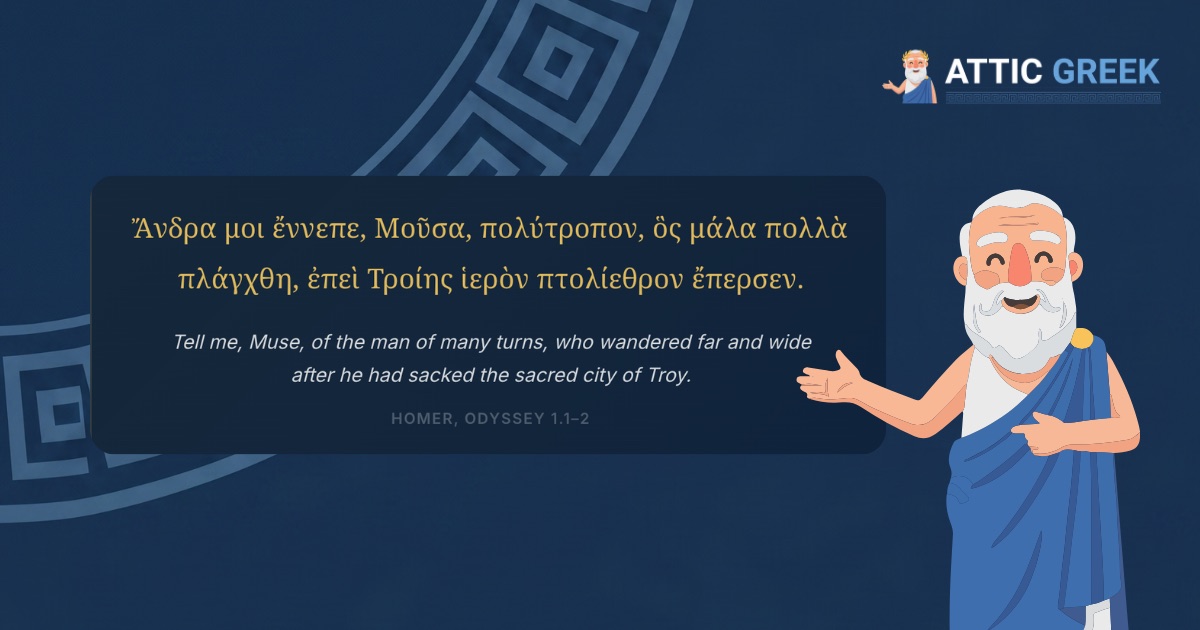
Ἄνδρα μοι ἔννεπε, Μοῦσα, πολύτροπον, ὃς μάλα πολλὰ
πλάγχθη, ἐπεὶ Τροίης ἱερὸν πτολίεθρον ἔπερσεν.Tell me, Muse, of the man of many turns, who wandered far and wide
Homer, Odyssey 1.1–2
after he had sacked the sacred city of Troy.
Every English translation you have ever read smooths this over. But look at the very first word: ἄνδρα — "man." Homer puts it first, before the verb, before even the Muse he is calling on. The entire epic announces its subject in its opening breath: a man. And the word chosen to describe him, πολύτροπον (polytropon), is almost untranslatable — literally "of many turns." A man of many journeys. A man of many tricks. A man turned in many directions by fate. No single English word holds all of that at once. This is what translation quietly costs you, and it is one of the best reasons to learn Ancient Greek.
Why learn Ancient Greek?
The honest answer is that Ancient Greek gives you something no translation can: the text itself, exactly as it was written, with all its precision and ambiguity intact.
Nearly everything foundational to Western thought was first written in this language. The philosophy of Plato and Aristotle. The histories of Thucydides and Herodotus. The tragedies of Sophocles and Euripides. The New Testament. The mathematics of Euclid. When you read these in translation, you are reading someone else's interpretation — a good one, perhaps, but a filter nonetheless. When you read them in Greek, the filter is gone.
There is also something the language does to you. Ancient Greek is precise in ways modern English is not. It marks whether an action is ongoing or completed, whether a wish is likely or merely hoped for, whether a "the" points to a specific thing or to an abstract ideal. Learning to read it trains a slower, more attentive kind of reading — the kind that has largely vanished from a world of feeds and skims. Many learners find this is the real reward: not just access to old books, but a sharpened mind.
What does the Odyssey's opening really say?
Return to those first two lines. A skilled translator has to choose one meaning for πολύτροπον and commit to it. But Homer's audience heard all the meanings at once, layered and simultaneous — the resourceful trickster, the much-traveled wanderer, the man twisted this way and that by the gods. The word is doing several jobs in a single breath, and that richness is exactly what gets flattened on its way into English.
A few lines later, Homer tells us what kind of man Odysseus was:
πολλῶν δ' ἀνθρώπων ἴδεν ἄστεα καὶ νόον ἔγνω.
He saw the cities of many men and came to know their minds.
Odyssey 1.3
Notice the pairing: he did not only see cities (ἄστεα), he came to know minds (νόον ἔγνω). Homer is telling us in one line that this will be a story not just of travel, but of understanding — of a man who learns what people are, everywhere he goes. In Greek, the two halves of the line balance each other like the two pans of a scale. That deliberate symmetry is invisible in most translations.
This is the quiet magic of reading in the original: the poem stops being a story someone told you about and becomes something you experience directly.
Which Greek should you learn first?
Ancient Greek is not one language but a family of related dialects. The three that matter most to readers are Homeric (the archaic dialect of the epics), Attic (the dialect of classical Athens), and Koine (the "common" Greek of the New Testament).
Most learners — and most university courses — begin with Attic Greek. It is the language of Plato, Aristotle, Thucydides, and the Athenian playwrights. It is the most thoroughly documented dialect, its grammar is the foundation of nearly every textbook, and once you know it, both Homeric and Koine Greek become far easier to approach. Start with Attic, and the rest of the Greek world opens up to you.
How hard is it, and how do you begin?
Ancient Greek has a fearsome reputation. Some of it is deserved — Thucydides is difficult even for scholars. But the beginning is far gentler than people expect, because the language is remarkably regular. It plays by its rules.
You start with the alphabet — 24 letters, many of which you already half-know from mathematics and science (alpha, beta, delta, pi, sigma, omega). From there you build vocabulary and grammar in small, connected steps. And unlike a modern language, you are not trying to order coffee or hold a conversation at speed — you are learning to read, patiently, with the text in front of you. That is a very achievable goal.
The best proof is this: you have already read three lines of Homer's Odyssey in the original Greek in this very article. A few weeks of steady practice, and lines like these stop being decoration and start being something you can actually decode yourself.
Homer knew what draws a person home across ten years and a hostile sea. He put it plainly:
ὣς οὐδὲν γλύκιον ἧς πατρίδος οὐδὲ τοκήων.
So there is nothing sweeter than one's own homeland, nor than one's parents.
Odyssey 9.34
Learning Ancient Greek is a little like that journey: long, occasionally demanding, and more rewarding than almost anything else you could choose to do with the time. And it begins with a single letter.
Start reading Homer in the original
Attic Greek teaches you Ancient Greek from the alphabet up — 210 structured lessons, quizzes, flashcards, and real passages from Homer, Plato, and the great classical authors, with Socrates himself as your guide. The lines from the Odyssey in this article are drawn straight from the app's own readings.
Start with 5 free lessons →Five lessons and the opening of the Odyssey, free forever. Then $4.99/month or $34.99/year.